Written by Charlotte Downie – AP Ventures
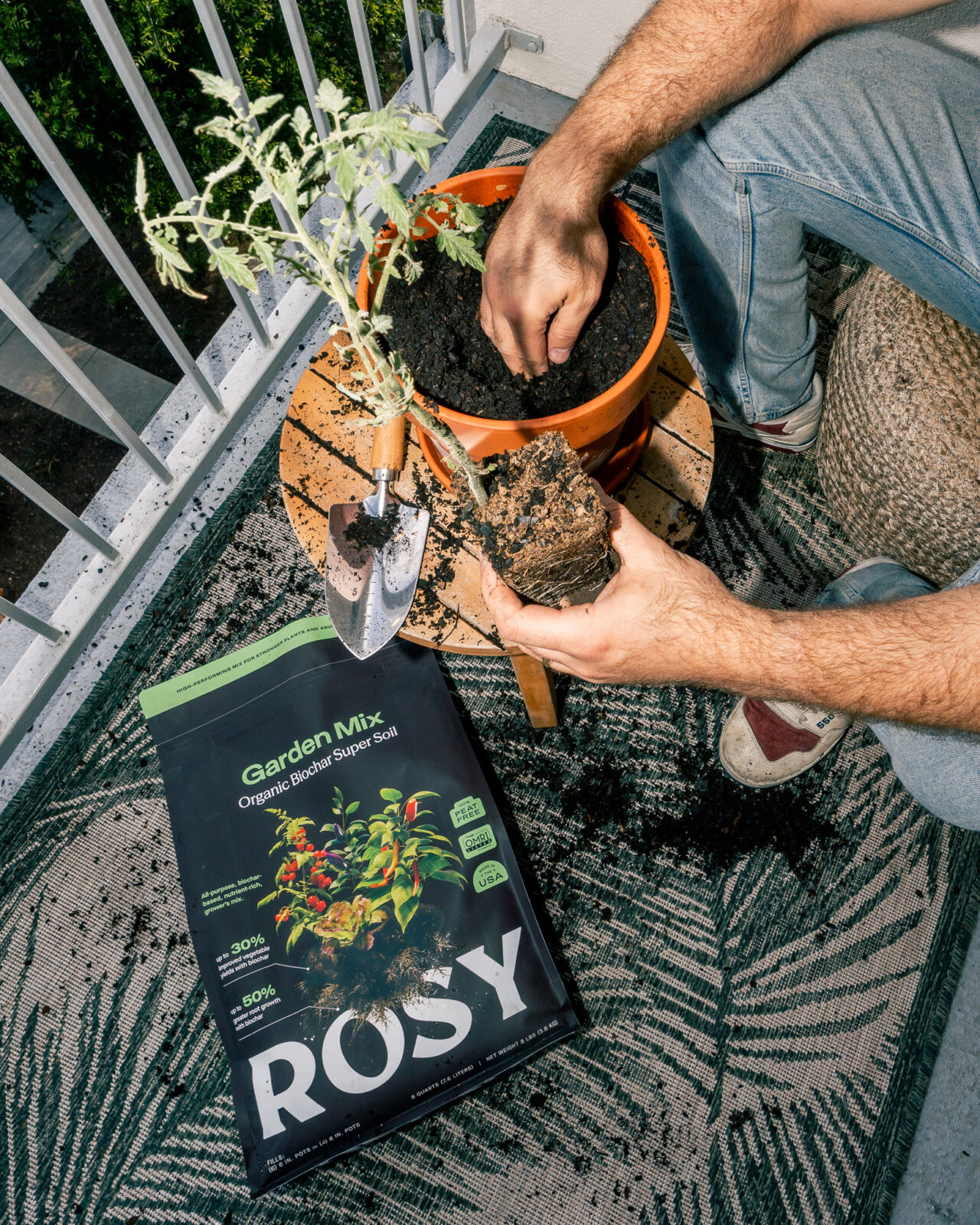
Most carbon removal is invisible and occurs at industrial plants, where no one will see. Rosy Soil’s carbon removal solution happens in a bag of potting mix on a garden centre shelf. This peat-free potting mix is formulated with biochar, which holds carbon pulled from the air and keeps it locked in the ground for hundreds of years. Rosy is building the consumer brand to bring this technology into millions of homes.
Peat moss has been the dominant ingredient in commercial potting soil since the 1960s. Valued for its moisture retention and consistency, it has been so ubiquitous that most never questioned its efficacy or environmental impact. That is now changing at different speeds in different markets. In the UK, most retailers have removed peat from shelves and bagged compost is prominently labelled “peat-free” ahead of incoming legislation and growing consumer awareness. However, in the US peat remains the unquestionable default. Ordinary garden soil doesn't work in pots as it compacts, drains poorly and starves roots of air, which is why potting mixes are engineered from lighter materials, with peat as the default choice for its moisture retention and consistency. However, peat's environmental cost is significant. Though peatlands cover just 3% of the Earth's surface, they store vast quantities of carbon built up over millennia. When peat is harvested and used in horticulture, it oxidises and emits approximately 385 kg of CO2 per cubic metre. Globally, drained and degraded peatlands contribute roughl, a disproportionately large carbon debt for a product sold in garden centres.
Regulators are beginning to respond. The UK is working through Parliament to ban and aims to eliminate professional use by 2030. The EU is moving in the same direction. In the United States, over 85% of peat is imported from Canada, and recent tariff pressures are already shifting the economics in favour of domestic alternatives. The transition is underway, but no US brand has yet established itself as the definitive peat-free alternative at the consumer level.
Biochar, a stable carbon-rich material produced by heating organic biomass in a low-oxygen environment, offers an answer. Unlike peat, which releases carbon when disturbed, biochar actively sequesters it. Once incorporated into soil, biochar can remain stable for centuries to millennia, functioning as a durable carbon sink. Like peat, it improves water retention, nutrient availability and microbial diversity, so plants thrive without the environmental trade-off. The Intergovernmental Panel on Climate Change (IPCC) recognised biochar as a potential negative emissions technology in its Sixth Assessment Report, and commercial adoption among growers has increased rapidly in recent years.
AP Ventures has followed the biochar space for several years, looking for companies that do not rely on carbon credits to realise economic value. Rosy Soil, founded in 2021 by Chad Massura, uses biochar rather than producing it, competing where the carbon reaches the consumer, in the bag of potting soil. Rosy holds a granted patent on its peat-free biochar blend, proven through extensive in-house plant trials, and its products outperform peat-based alternatives on root growth, microbial life and water efficiency. Its carbon footprint is around a third of that of peat-based mixes, and the biochar in each bag locks carbon away for centuries. Rosy is still early in its commercialisation, but the model compounds: every bag sold adds to the carbon removed, and the company sequestered over 1,100 tonnes of CO2 in 2025 alone.
Product performance has converted into commercial traction, shown in national retail accounts and strong repeat purchases, through tactics that would take competitors years to replicate including a secured biochar supply and the state-level registrations needed to sell soil across the US.
UK retailers have already moved beyond peat, the EU is following, and US tariff pressure on Canadian imports is shifting the economics. No US brand has yet defined the peat-free category. With Rosy, AP Ventures is backing a consumer brand with the science to back it up. Decarbonisation does not happen only at an industrial scale; sometimes it starts in a bag of soil.
If you are interested in sustainable consumer technologies, carbon removal, or the future of biochar, we would be glad to connect. Reach out to the AP Ventures team to learn more.
Peat Soils, SpringerLink, Springer. https://link.springer.com/referenceworkentry/10.1007/978-3-319-39193-9_39-1
Gunther, A., Barthelmes, A., Huth, V. et al. Prompt rewetting of drained peatlands reduces climate warming despite methane emissions. Nature Communications (2020). https://doi.org/10.1038/s41467-020-15499-z
Peat: restrictions on use in horticulture, UK Government, GOV.UK (2026).
Horticultural Peat (Prohibition of Sale) Bill - Parliamentary Bills - UK Parliament
The Growing Media Market: Tariffs, Trends, and What Lies Ahead, Greenhouse Grower (2025). https://www.greenhousegrower.com/production/the-growing-media-market-tariffs-trends-and-what-lies-ahead/
Removing Carbon, International Biochar Initiative. https://www.biochar-international.org/removing-carbon/
Climate Change 2022: Mitigation of Climate Change, Sixth Assessment Report, Working Group III. Intergovernmental Panel on Climate Change (2022). https://www.ipcc.ch/report/ar6/wg3/
Manufactured Soil Market Size, Share & Growth Report, 2033, Research and Markets. https://www.researchandmarkets.com/reports/5892773/manufactured-soil-market-size-share-and-growth
2026 Life Cycle Assessment: Calculating the Emissions of our Products, Rosy Soil (2026). https://rosysoil.com/blogs/news/2026-life-cycle-assessment-calculating-the-emissions-of-our-products